19 October 2026 | Allure Weightloss Dubai

Not losing weight on Mounjaro as quickly as you expected? Perhaps you’ve recently started treatment, your appetite hasn’t changed much, or you’ve been losing weight successfully but have now reached a plateau.
These are common concerns among people using Mounjaro for weight loss in Dubai.
Mounjaro (tirzepatide) has demonstrated substantial weight-loss results in clinical research. In the landmark SURMOUNT-1 trial, participants receiving the highest studied dose of 15 mg achieved an estimated 22.5% average reduction in starting body weight over 72 weeks under the study’s efficacy analysis.
That’s an important result, but it’s also important to understand that weight loss develops over time, individual responses vary, and not everyone requires or tolerates the highest dose.
Some patients notice appetite changes within the first few weeks. Others experience more gradual progress as their treatment develops. Even patients who initially lose weight consistently may later experience periods when the scales barely move.
In this guide, we explain how quickly Mounjaro works, why weight loss can be slower than expected, what causes plateaus and when to review your treatment with a licensed clinician.
How Much Weight Can You Lose on Mounjaro?
Mounjaro contains tirzepatide, which acts on two hormone receptors involved in appetite and metabolic regulation: GIP and GLP-1.
It can help patients feel fuller, reduce hunger and manage food intake more effectively.
But how much weight loss is actually possible?
Mounjaro Clinical Trial Results — Up to 22.5% Average Weight Loss
The SURMOUNT-1 clinical trial followed adults with obesity, or overweight with a related health condition, who did not have diabetes.
Participants received tirzepatide at different maintenance doses alongside lifestyle intervention.
At 72 weeks, estimated average weight reductions under the study’s efficacy analysis were:
- 5 mg: 16.0% average body-weight reduction
- 10 mg: 21.4% average body-weight reduction
- 15 mg: 22.5% average body-weight reduction
The study also reported results accounting for treatment discontinuation, including an average reduction of 20.9% in the 15 mg group.
These results demonstrate the significant weight-loss potential of tirzepatide over a sustained treatment period.
However, they are clinical trial averages rather than predictions for individual patients. The highest result was associated with the highest studied dose under the specified analysis.
Patients may respond differently depending on medical history, treatment duration, prescribed dose, tolerance, nutritional habits and other factors.
The key message is that Mounjaro can support substantial weight reduction, but meaningful results are typically assessed over months rather than a few weeks.
How Quickly Does Mounjaro Start Working?
One of the most frequent questions we receive at Allure Weightloss is how long it takes to notice results.
The answer varies.
Some people experience reduced appetite soon after starting treatment, while others require more time.
The First Month — Starting Treatment
Mounjaro is normally introduced at 2.5 mg once weekly.
This is a starting dose designed to help the body adjust to the medication.
During the first four weeks, patients may experience:
- Reduced hunger or fewer cravings.
- Feeling satisfied with smaller meals.
- Less interest in frequent snacking.
- Early reductions in body weight.
- Little noticeable change while their body adjusts.
All of these experiences can occur.
The first month is not necessarily representative of the results a patient may achieve over a longer treatment period.
Months Two and Three — Building Treatment Response
Following the introductory period, the prescribing clinician may recommend dose progression according to the patient’s response and tolerability.
For some patients, this is when changes in appetite and weight become more noticeable.
Others may already be progressing well at a lower dose.
It’s important not to assume that increasing the dose is always necessary or that higher doses automatically provide a better experience.
The treatment plan should be individualised.
Three Months and Beyond — Reviewing Progress
As treatment continues, patients and clinicians can assess weight trends, appetite changes, side effects and overall progress.
Significant weight reduction may accumulate over many months, as demonstrated in clinical studies.
Some patients experience relatively consistent progress, while others lose weight in stages with occasional periods of little change.
Regular reviews help determine whether the current approach remains suitable.
How Much Weight Can You Lose in the First Month?
Patients frequently ask us whether they can lose a particular number of kilograms within their first four weeks of treatment.
It’s understandable to want a timeline, especially when starting a new medical weight-loss programme.
However, there is no reliable way to promise a specific amount of weight loss in the first month on Mounjaro.
Several factors influence the result, including starting weight, previous weight-loss attempts, existing medical conditions, nutritional intake and individual response to tirzepatide.
Why Some Patients Lose Weight Faster Initially
Early changes on the scales may reflect a combination of reduced food intake, changes in body water, glycogen stores and actual body-fat reduction.
People starting at a higher body weight may also experience larger absolute changes in kilograms than those starting at a lower weight.
This is one reason why measuring progress as a percentage of starting body weight can sometimes be more meaningful than comparing kilograms lost between individuals.
Why Others Lose Weight More Gradually
Some patients experience a slower change in appetite during the introductory treatment period.
Others may already have relatively balanced eating habits, or their progress may be influenced by other health and lifestyle factors.
A slower first month does not automatically mean the medication is ineffective.
Equally, unusually rapid weight loss should not always be celebrated without considering hydration, nutritional intake and overall health.
The goal is clinically meaningful, sustainable weight reduction — not reaching an arbitrary number by the end of the month.
Seven Reasons You May Not Be Losing Weight on Mounjaro
If your results are slower than anticipated, several factors may explain what’s happening.
Understanding these factors can help you have a more useful discussion with your clinical team.
1. You’re Still Early in Treatment
One of the most common explanations is simply that treatment has only recently begun.
The first few weeks involve introducing the medication and assessing tolerability.
Although some patients respond quickly, others notice more significant changes as treatment continues.
It’s important not to judge an entire weight-loss programme after only one or two injections.
2. Your Prescribed Dose May Need Reviewing
Mounjaro is introduced gradually, with dose adjustments made when clinically appropriate.
Some patients respond well at lower doses.
Others may require subsequent changes in their prescribed treatment before experiencing adequate appetite control and weight reduction.
However, higher doses can also increase the likelihood of side effects.
Your prescribing clinician should review your response before considering any adjustment.
Never increase your Mounjaro dose or shorten the interval between injections without medical instructions.
3. You’re Consuming More Calories Than You Realise
Mounjaro helps regulate appetite, but total nutritional intake remains relevant to weight management.
Even when someone is eating smaller meals, additional calories can come from snacks, drinks, sauces, alcohol or frequent eating throughout the day.
In Dubai, restaurant meals, social occasions and irregular work schedules can also make consistent eating habits challenging.
A dietitian can help review your meal structure, portion sizes and nutritional requirements.
The aim isn’t to eat as little as possible. It’s to support a sustainable energy deficit while maintaining adequate nutrition.
4. Your Physical Activity Has Changed
Movement supports cardiovascular health, weight management and the maintenance of muscle mass.
However, exercise does not always produce an immediate reduction on the scales.
Starting a new training programme can temporarily affect fluid retention, while changes in activity levels may influence overall energy expenditure.
Patients who exercise frequently may also notice increased hunger after demanding sessions.
A balanced approach to exercise, hydration and nutrition is often more useful than simply trying to burn additional calories.
5. Sleep and Stress May Be Affecting Your Progress
Poor sleep and sustained stress can influence hunger, energy levels, eating behaviour and treatment adherence.
For people balancing demanding jobs, family responsibilities and busy lifestyles in Dubai, these factors can sometimes be overlooked.
Reviewing sleep patterns, recovery and daily routines may identify opportunities to support the overall treatment plan.
6. Other Medical Factors May Be Involved
Weight-management responses can be affected by existing health conditions or other medicines.
Examples include certain thyroid disorders, poorly controlled diabetes, sleep apnoea and medications associated with weight gain.
Where progress remains unexpectedly limited, the prescribing clinician may recommend further review or investigation.
Patients should not stop existing medication without medical advice.
7. You’ve Reached a Weight-Loss Plateau
Perhaps you’ve already lost a meaningful amount of weight, but the scales have barely changed recently.
This may be a plateau.
As body weight decreases, energy requirements can change, and the rate of further weight loss may slow.
Appetite, food intake, activity and other factors may also change during treatment.
A plateau doesn’t automatically mean that Mounjaro has stopped working.
However, persistent stagnation deserves an appropriate clinical review.
What Is a Mounjaro Weight-Loss Plateau?
A weight-loss plateau is a sustained period when body weight remains relatively stable after an earlier period of reduction.
It is different from a single week when the scales don’t change.
Weight naturally fluctuates because of hydration, digestive contents, salt intake, constipation and other factors.
A more useful approach is to examine the overall trend over several weeks.
Why Do Plateaus Happen?
Possible explanations include:
- Lower energy requirements after losing weight.
- Changes in appetite or food intake.
- Reduced daily movement.
- Temporary fluid retention.
- Changes in exercise or recovery.
- Other medical or lifestyle factors.
There may be more than one contributing factor.
Does a Plateau Mean Mounjaro Has Stopped Working?
Not necessarily.
Some periods of weight stability occur during otherwise successful treatment.
The important distinction is between a temporary pause and a persistent lack of response requiring medical reassessment.
If your weight has remained unchanged for several weeks despite following your treatment plan, a review may help identify the next step.
What Should You Do When Mounjaro Weight Loss Slows?
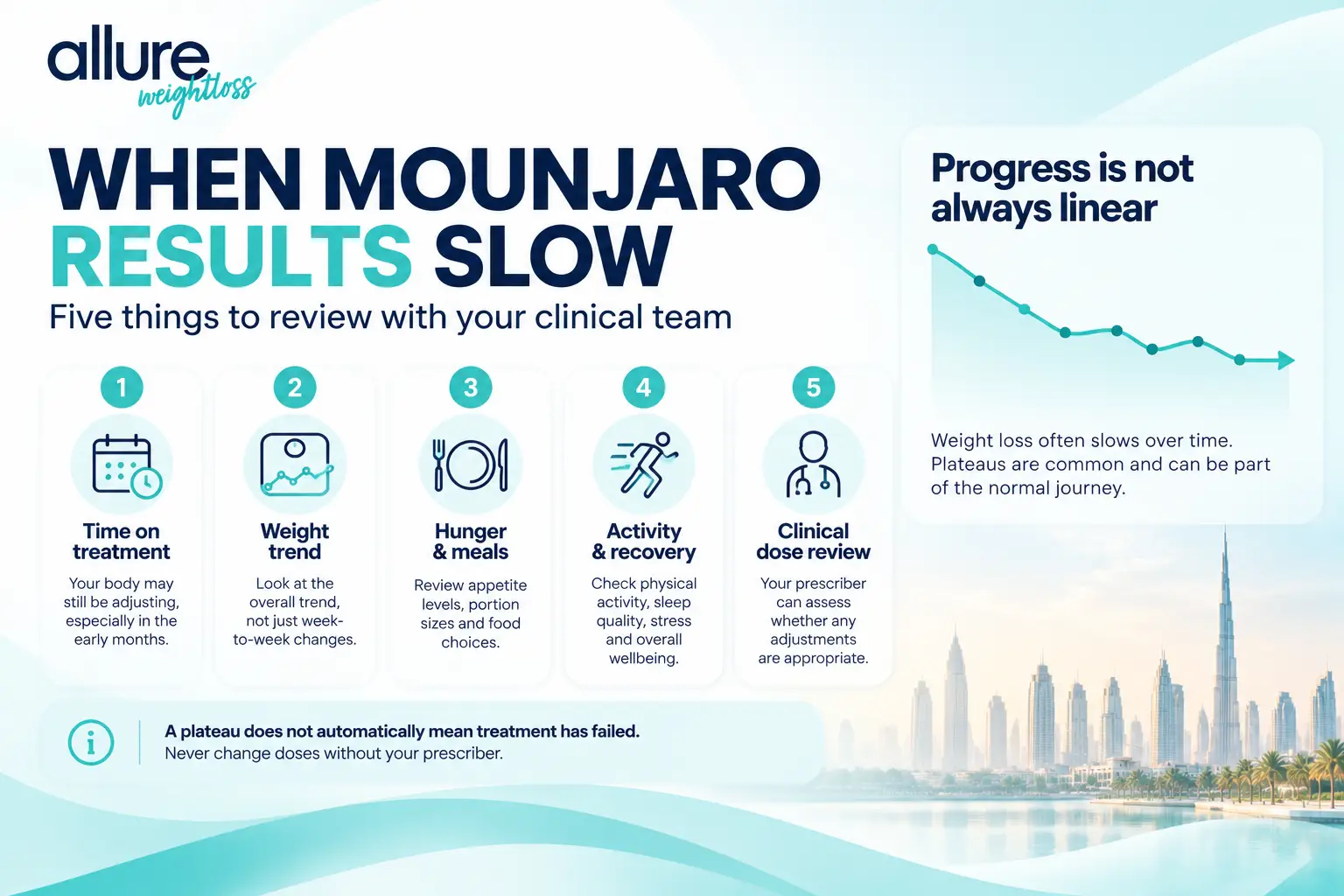
Rather than immediately assuming that you need a higher dose, it’s worth reviewing several areas.
Review Your Weight Trend
Look at your progress over a meaningful period, rather than focusing on individual weigh-ins.
Record measurements under reasonably consistent conditions.
Changes in waist measurement and other relevant health indicators may provide additional context.
Review Your Eating Habits
Consider portion sizes, protein intake, snacks, drinks and how regularly you are eating.
A structured dietary review can identify issues that may not be obvious.
Adequate nutrition remains essential during medical weight loss.
Review Exercise and Muscle Maintenance
Resistance training and appropriate physical activity can help preserve muscle mass and support overall health during weight reduction.
Patients should choose activities appropriate to their fitness, health and treatment circumstances.
Review Your Medication Response
Discuss hunger, cravings, side effects and your prescribed dose with your clinician.
If your treatment response is inadequate, the prescriber can assess whether a change is appropriate.
Review the Overall Plan
Weight management is influenced by several factors beyond medication alone.
Sleep, stress, other health conditions and the sustainability of your routine all deserve consideration.
A coordinated clinical and nutritional review may be more valuable than focusing solely on the number shown on the scales.
I’m Still Hungry on Mounjaro 2.5 mg — Is That Normal?
Yes, some patients continue to experience hunger or cravings while taking the introductory 2.5 mg dose.
This can be frustrating, particularly when others describe feeling full after only a small amount of food.
However, not everyone experiences appetite suppression at the same stage of treatment.
For some patients, appetite changes become more noticeable as treatment progresses under clinical supervision.
Hunger can also vary in response to activity, sleep, meal timing and nutritional intake.
Feeling hungry during the first month does not automatically mean Mounjaro isn’t working.
If you’re experiencing persistent hunger or cravings that interfere with your programme, discuss them with your clinical team.
Why Am I Losing Weight More Slowly Than Other People on Mounjaro?
Comparing your progress with friends, colleagues or social media posts can be misleading.
Two people taking the same medicine may have very different starting weights, medical histories, lifestyles and treatment responses.
A patient starting at a substantially higher body weight may lose more kilograms while achieving a similar percentage reduction.
Other differences include:
- Current treatment duration.
- Prescribed and tolerated dose.
- Previous exposure to weight-loss medication.
- Individual appetite response.
- Physical activity and muscle mass.
- Eating habits and nutritional requirements.
- Existing health conditions.
Clinical trial averages provide evidence of a treatment’s potential, but they don’t establish exactly what any individual patient should weigh after a particular number of weeks.
The most useful comparison is usually your own progress relative to your starting point and agreed treatment goals.
Can Mounjaro Stop Working After Several Months?
Some patients notice that their appetite suppression becomes less noticeable after several months.
Others experience a reduction in their rate of weight loss after losing a substantial amount of weight.
Neither observation automatically means the medication has stopped working.
A review should distinguish between normal changes during treatment, a sustained plateau, returning appetite and genuine weight regain.
Depending on the circumstances, the clinician may consider nutritional changes, additional investigations, treatment adjustment or another medically appropriate pathway.
Patients should not independently combine weight-loss medicines or alter their prescribed dose.
When Should You Speak to Your Prescribing Clinician?
A clinical review is particularly important if:
- Your progress remains limited after an appropriate treatment period.
- You experience persistent hunger despite following your programme.
- Weight loss has stopped for a sustained period.
- You’ve begun regaining weight.
- Side effects are making treatment difficult.
- You’re struggling to maintain adequate nutrition or hydration.
- You want to discuss a dose change or alternative medication.
Severe abdominal pain, repeated vomiting, significant dehydration or symptoms of a serious allergic reaction require prompt medical assessment.
Do not wait for a routine programme review if serious symptoms develop.
How Allure Supports Mounjaro Patients in Dubai
At Allure Weightloss, we recognise that patients need different levels of support throughout their treatment.
Some people progress steadily and require relatively limited intervention.
Others benefit from additional dietary guidance, symptom management or clinical review when weight loss slows.
Our Core, Support and Premium Mounjaro programmes provide different levels of support according to patient requirements.
Depending on the programme and clinical circumstances, support may include:
- Medical assessment and prescribing coordination.
- Monitoring treatment progress.
- Appropriate dose and tolerability reviews.
- Dietitian-led nutritional guidance.
- Managing common treatment concerns.
- Reviewing hunger, cravings and plateaus.
- Planning longer-term weight maintenance.
Prescribing and medical decisions are made by appropriately licensed UAE clinicians, while Allure coordinates the agreed programme and patient support.
Explore our Mounjaro weight loss programme in Dubai for more information.
What If Mounjaro Isn’t the Right Treatment for You?
Although tirzepatide has demonstrated substantial weight-loss results in clinical trials, it is not suitable or effective for every patient.
Some individuals experience inadequate weight loss or side effects that limit treatment.
In those circumstances, a clinician may consider whether alternative medicines or other weight-management approaches are appropriate.
Allure’s wider treatment options include Wegovy, oral weight-management medication, gastric balloons and bariatric surgery through licensed clinical providers.
The correct approach depends on individual suitability, previous treatment, medical history and preferences.
Want to explore your other weight-loss options? Allure’s 360° Treatment Finder helps you compare medical weight management, gastric balloons and bariatric surgery. Enter your starting weight to see how published research results translate into kilograms, alongside indicative treatment costs in Dubai.
Explore the 360° Treatment Finder
Frequently Asked Questions
Why am I not losing weight on Mounjaro?
Possible reasons include being early in treatment, an inadequate treatment response, dietary factors, changes in physical activity, other medical conditions or a weight-loss plateau. A clinician can help identify the most relevant factors.
How quickly will I lose weight on Mounjaro?
The timeline varies between patients. Some notice changes during the first month, while others experience more gradual progress. Clinical trials demonstrate substantial potential over many months rather than a guaranteed weekly or monthly result.
How much weight can Mounjaro help me lose?
In SURMOUNT-1, patients receiving tirzepatide 15 mg achieved an estimated average body-weight reduction of 22.5% at 72 weeks under the efficacy analysis. Individual results vary, and not everyone requires or tolerates the highest dose.
Why am I not losing weight on Mounjaro 2.5 mg?
The 2.5 mg dose is used to introduce treatment and improve tolerability. Not everyone experiences substantial weight reduction at this stage. Discuss your response and next steps with your prescriber.
Why am I still hungry on Mounjaro?
Appetite suppression varies between patients and across treatment stages. Nutritional intake, activity, sleep and medication response may all influence hunger.
Why has my Mounjaro weight loss stopped?
You may be experiencing a temporary plateau. Changes in energy requirements, food intake, activity or other factors can contribute. Persistent stagnation should be assessed clinically.
Should I increase my Mounjaro dose if my weight loss slows?
Never change the dose yourself. Your prescribing clinician should review your response, tolerability and treatment history before determining whether an adjustment is appropriate.
Can I switch to another weight-loss treatment?
Alternative approaches may be considered following medical assessment. Patients should not independently switch or combine prescription weight-loss medicines.
Considering Mounjaro in Dubai or Concerned About Slow Progress?
Mounjaro has demonstrated substantial weight-loss potential, but a successful programme involves more than the medication itself.
Realistic expectations, appropriate clinical monitoring, nutrition and ongoing support all contribute to a sustainable approach.
Whether you’re considering Mounjaro for the first time or reviewing your progress after several months, Allure Weightloss can help you understand the available options and coordinate appropriate clinical support.
Explore Allure’s Mounjaro Weight Loss Programme in Dubai →
Medical disclaimer: This article is for general educational purposes and does not replace individual medical advice. Mounjaro is a prescription medication and is not suitable for everyone. Treatment decisions and dose changes must be made by an appropriately licensed clinician.